If you have ever stood in the outdoor cushion aisle holding two pillows that you love but you are not sure they love each other, you are in the right place. Mixing and matching seasonal outdoor throw pillows is one of the easiest ways to make your porch or patio feel refreshed for spring, bright in summer, cozy in fall, and still inviting when the days get short.
The secret is not owning a mountain of pillows. It is having a small “pillow wardrobe” with a dependable base, a simple pattern plan, and a few seasonal swaps that do the heavy lifting.

Start with a porch-friendly plan
Before we talk seasons, let’s make sure the mix-and-match part feels easy. When I am styling my own deck, I follow three little rules that keep things looking pulled together, not chaotic.
Rule 1: Pick a base color you will never get tired of
Your base color is the “always” in your outdoor space. Think of it like jeans. It goes with everything, hides a little dirt, and makes the seasonal colors look intentional.
- Best base neutrals for outdoors: oatmeal, taupe, greige, warm white, charcoal, navy
- If you have lots of plants: soft cream or flax looks fresh against green
- If your furniture is dark metal or black: warm neutrals keep it from feeling too stark
I like to keep 50 to 70 percent of my pillows in this base family year-round. That way, swapping seasons is mostly adding and subtracting accents.
Rule 2: Use a simple ratio
For most seating setups, this pattern mix works beautifully:
- 2 solids (or very subtle textured solids)
- 1 stripe or geometric
- 1 floral or organic print
How to use it without awkward counts: if your sofa looks best with four pillows, use the ratio once (2 solids, 1 stripe, 1 floral). If you style with six pillows, keep three solids and add one stripe plus two prints, or repeat the ratio and drop one solid. On a sectional, you can repeat the four-pillow mix on each end.
Rule 3: Repeat one color at least twice
When a color appears in two places, the whole arrangement clicks. It can be two pillows, or a pillow plus a planter, or a pillow plus an outdoor rug. Repetition is the quickest way to make “mix and match” look like you meant it.
Pick a year-round palette
If you want to buy fewer pillows overall, build your seasonal looks from one flexible palette. Here are three I see work over and over again on porches and patios.
Palette A: Coastal easy
- Base: cream or oatmeal
- Anchor: navy
- Seasonal pops: sky blue (spring), coral (summer), rust (fall), evergreen (winter)
Palette B: Warm and welcoming
- Base: taupe or warm white
- Anchor: camel or tobacco brown
- Seasonal pops: sage (spring), citron (summer), mustard (fall), cranberry (winter)
Palette C: Modern garden
- Base: greige or light gray
- Anchor: charcoal
- Seasonal pops: soft lilac (spring), bright green (summer), terracotta (fall), deep teal (winter)
Pick one palette that matches your home exterior and your existing outdoor rug if you have one. That little alignment makes every seasonal swap feel smoother.
Mix patterns on purpose
Patterns are where most people get stuck, so here is my no-stress method.
Vary the scale
Choose one pattern in each size category:
- Large scale: bold floral, oversized leaf, big check
- Medium scale: classic stripe, geometric, block print
- Small scale: dotted texture, tiny gingham, subtle global print
When patterns are different sizes, your eye can sort them. When they are all the same size, they compete.
Use one “quiet” pattern as the peacemaker
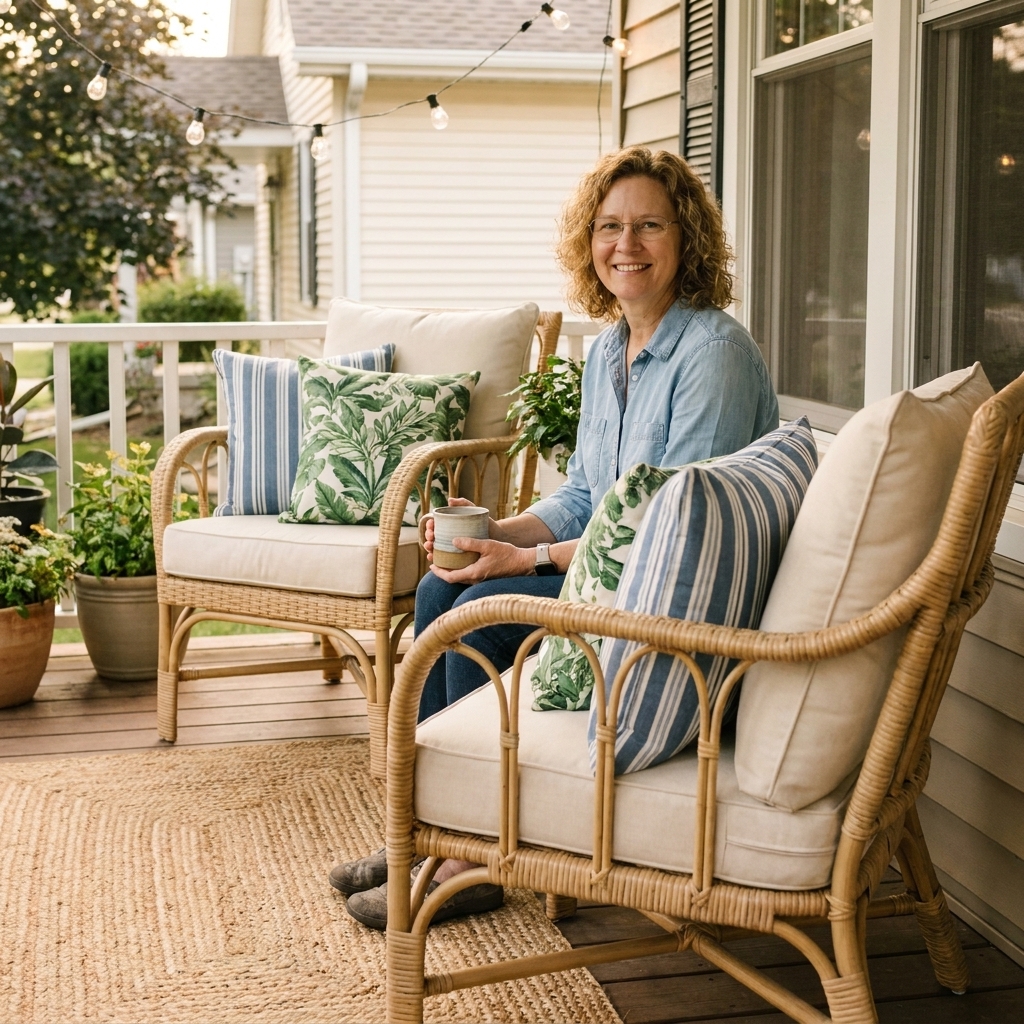
Stripes are the best peacemaker on a porch. They feel crisp in spring and summer, cozy in fall when paired with warmer tones, and classic in winter with deeper colors.
Keep the color story tight
If you are mixing prints, limit yourself to:
- 1 base neutral
- 1 anchor (navy, charcoal, or a deep green)
- 1 seasonal accent
- Optional: a tiny touch of a second accent if it shows up in more than one place
Season-by-season swaps
This is the fun part. Think of your core pillows as your everyday outfit, and seasonal pillows as the scarf, jacket, or earrings that change the vibe.
Spring: fresh and light
Color moves: soften everything by leaning into lighter tones and fresh greens.
- Best accents: sage, robin’s egg blue, butter yellow, blush
- Patterns that shine: small florals, delicate stripes, watercolor botanicals
- Texture tip: add one nubby woven or slub-texture pillow for that airy, new-season feel
My spring formula: keep your base neutrals, add one floral pillow, and swap one solid for a soft pastel.

Summer: bold and sun-happy
Color moves: turn up the saturation, especially if your porch has lots of shade.
- Best accents: coral, turquoise, citron, cobalt, tomato red
- Patterns that shine: wide stripes, playful geometrics, tropical leaves
- Texture tip: choose smooth performance fabric or quick-dry covers if you get afternoon storms
My summer formula: one strong stripe, one bold solid, and keep at least one neutral pillow so the bright ones look chic, not loud.

Fall: cozy and warm
Color moves: bring in warm earthy tones that look gorgeous against fading greenery.
- Best accents: rust, terracotta, mustard, olive, deep burgundy
- Patterns that shine: plaids, block prints, warm-toned botanicals
- Texture tip: look for outdoor pillows with a woven, boucle-like, or knit-look texture that still dries well
My fall formula: swap in two warm solids and keep one year-round stripe. Add one patterned pillow that includes your anchor color so everything ties together.

Winter: calm and softly festive
Color moves: go deeper and quieter. Winter outdoor spaces look best with a little contrast and a little glow.
- Best accents: evergreen, navy, cranberry, black, warm ivory
- Patterns that shine: ticking stripe, small check, simple botanical silhouettes
- Texture tip: choose pillows with a tighter weave, and keep a cozy throw blanket nearby for the softness
My winter formula: keep the base neutrals, add one deep anchor pillow (navy or evergreen), and one small-pattern pillow for interest. Let lights and greenery be the sparkle.

How many pillows do you need?
You can absolutely do this without a storage headache. Here is a practical setup that covers all four seasons.
A simple pillow wardrobe
For one chair: start with 1 pillow. If you want a layered look, add 1 lumbar.
For a loveseat or bench:
- 2 base solid pillows (neutral)
- 1 anchor pillow (navy, charcoal, deep green)
- 1 year-round stripe pillow
- 2 seasonal accent pillows (swap colors seasonally)
That is 6 pillows total, and only two truly need to change each season.
For a sofa or sectional
Most standard sofas look great with 4 to 6 pillows. Deep seating can handle larger sizes and an extra layer. For sectionals, repeat your “four-pillow mix” on each end, then add one lumbar in the middle if you like that styled feel. Lumbars are my favorite small swap because they are usually cheaper and easier to store.
Pillow sizing made simple
If pillows always look a little too small on your outdoor furniture, it is usually a size issue, not a style issue.
- Standard chairs: 18x18 or 20x20
- Deep seating and roomy sofas: 20x20 or 22x22 (as the back layer)
- Lumbar for layering: 12x20 or 14x20
My easy trick: go one size up for the back pillow, then add a lumbar in front. It instantly looks more tailored.
Fabric details that matter
Pretty is wonderful, but outdoor pillows have to earn their keep. These are the features I look for when I want pillows to last beyond one season.
- Solution-dyed acrylic is typically excellent for fade resistance (many Sunbrella-type outdoor fabrics fall in this family), but always check the label since “outdoor” can mean different things.
- Polyester performance fabric can be very durable, but quality varies by weave, coatings, and any UV treatment. If the listing includes a UV or fade rating, that is a helpful sign.
- Removable covers with a zipper so you can wash or replace just the cover
- Quick-dry inserts or water-resistant fills if your porch is uncovered. Water-resistant is not the same as waterproof, so airflow and drying time still matter.
- Double-stitched seams to help reduce the risk of corners splitting after a lot of lounging
If you already have pillows you love but the inserts feel sad and slumpy, replace the inserts before buying all new covers. Fresh inserts make everything look crisp again.
Match pillows to your climate
Outdoor pillow success depends a lot on what your porch deals with every day. A few quick tweaks make a big difference.
- Full sun: choose darker anchors sparingly (they can fade fastest) and look for fade ratings when you can.
- Uncovered patios: prioritize quick-dry inserts and breathable storage so pillows can fully dry between storms.
- Coastal air: rinse off salt spray occasionally and bring pillows in during heavy wind or squalls.
- High pollen areas: pick mid-tone bases (they hide the yellow dust best) and plan on a quick rinse or gentle wash in peak season.
Care basics between swaps
Seasonal pillows stay nice longer when they are stored clean and completely dry.
- Brush off pollen and dirt, then let pillows dry fully before storing
- Spot-clean as needed with mild soap and water, then rinse and air-dry
- If covers are machine-washable, use cold water and gentle cycle, and follow the care label
- Air-dry covers when possible, or tumble dry low only if the label allows it
- Store in a breathable fabric bin or a lidded tote with a moisture absorber
- Keep covers and inserts together so swapping is truly quick
If you live somewhere humid, avoid sealing damp pillows in an airtight container. That is how musty smells and mildew sneak in.
Styling tricks that look designer
Mix shapes, not just prints
Even if all your pillows are in the same color family, different shapes add that styled feel.
- Pair two 20x20 squares with a 14x20 lumbar
- Add one oversized 22x22 as the back layer for a plush look
Use counts that feel balanced
This is more “rule of thumb” than rule, but it works often: chairs usually look best with an odd-number feel (one main pillow, or one plus a lumbar), and sofas tend to look more balanced with even numbers (two per side).
Pull one color from your surroundings
This is my favorite no-spend trick. If you have terracotta pots, black railings, a navy front door, or a red brick exterior, echo that tone in a pillow. It looks custom because it is connected to your home.
Quick mix-and-match examples
Neutral furniture, lots of plants
- Base: oatmeal
- Anchor: deep green
- Year-round: thin black-and-cream stripe
- Seasonal swap: blush floral for spring, coral solid for summer, rust block print for fall, ivory check for winter
Black metal furniture, modern vibe
- Base: light gray
- Anchor: charcoal
- Year-round: gray-and-white cabana stripe
- Seasonal swap: lilac accent for spring, citron for summer, terracotta for fall, deep teal for winter
Classic wicker on a front porch
- Base: warm cream
- Anchor: navy
- Year-round: blue ticking stripe
- Seasonal swap: soft blue floral in spring, coral geometric in summer, mustard plaid in fall, cranberry botanical in winter
FAQ
How do I keep mixed patterns from looking busy?
Limit your palette to one base neutral, one anchor color, and one seasonal accent. Then vary pattern scale, and make sure at least one pillow is a solid or a very subtle texture solid.
What is the easiest pattern to mix with anything?
A simple stripe. It plays nicely with florals, geometrics, and solids, and it works in every season.
Can I leave outdoor pillows outside year-round?
You can, but they last much longer if you bring them in during heavy rain, snow, and long stretches of direct sun. If you love the look of pillows outdoors in winter, choose water-resistant covers, keep airflow in mind, and store extra sets indoors.
Should my pillows match my outdoor rug?
They do not need to match, but they should share a color. If your rug has navy, repeat navy in at least one pillow and your whole setup will feel coordinated.
A final neighborly tip
If you want that “pro” look with the least effort, invest in a great stripe and two base neutrals you truly love, then let the seasons handle the rest with one or two accent swaps. It is one of the most budget-friendly ways I know to make your porch feel brand new, four times a year.